Design leadership · Case study
Workshops & mentoring
Taking one disputed interaction from a workshop into a standard a developer can use.
- My role
- Design facilitator, mentor and contributor to UX standards and the team handbook.
- Project scope
- Problem-framing sessions, design-system and accessibility workshops, critique and handoff.
- Delivery
- Shared decisions carried into the procurement programme’s UX standards.
APPROACH / Design leadership
My design process
How I approached facilitation and critique, from the first question to a concrete design decision.
Frame a real disagreement
Bring a concrete task or edge case into the room.
OUTPUTShared problem statementWork through the behaviour
Discuss the user’s task with design, engineering and business stakeholders.
OUTPUTAgreed interactionRecord the reasoning
Capture when the rule applies and why the team chose it.
OUTPUTReusable standardBuild independent judgement
Use critique to test a choice against the task and identify justified exceptions.
OUTPUTActionable feedback
Agreement on the screen can hide disagreement about behaviour
A grid can look finished while designers and engineers still have different answers about blank fields, keyboard navigation or failed edits. In a review, those differences surface late. I use a workshop when the team needs to agree on a rule that will apply to more than one screen.
Bring a real edge case into the room
In problem-framing sessions such as Chaos to Clarity, I start with the task and the point at which people disagree. A blank-value filter is a useful example: a missing classification can be exactly what an operator wants to find. That concrete question gives engineering, design and business stakeholders something they can resolve together.
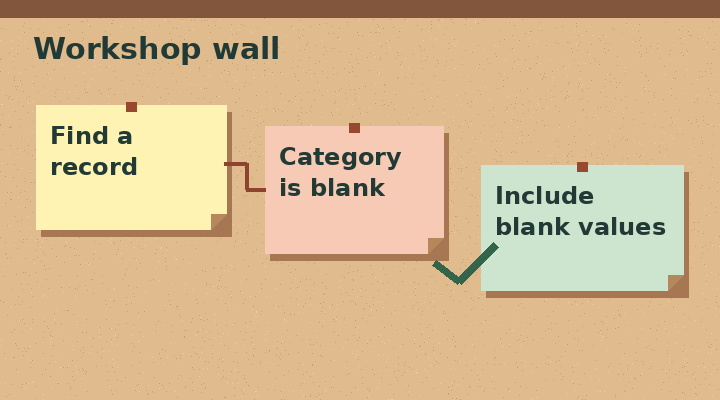
Find an unclassified record. The field is blank. Include blanks in the filter.
Write down enough to reuse the decision
I capture the agreed behaviour, its rationale and the situations in which it applies. On the procurement programme, standards for filters, table navigation, validation and feedback moved into a shared handbook. A designer could cite the rule in a review and a developer could check an implementation against it.
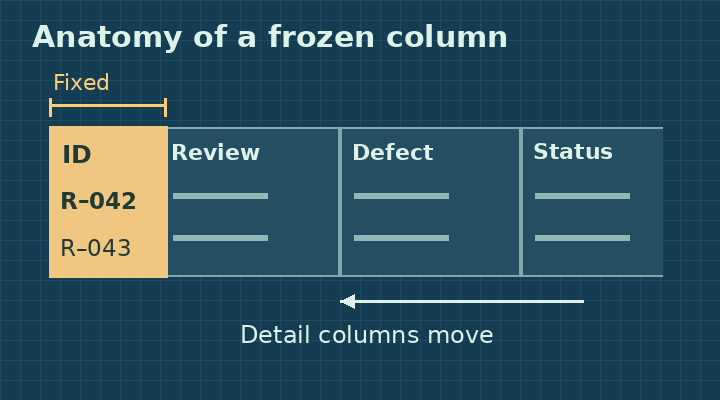
Keep the identifier visible. A wide table can hide row context. Apply the rule in the next grid.
Use critique to build judgement
When mentoring a designer, I ask them to explain the task and the consequence of their choice before discussing the visual result. The shared standard becomes a reference point. If the new situation differs, the team can identify why the rule needs an exception.
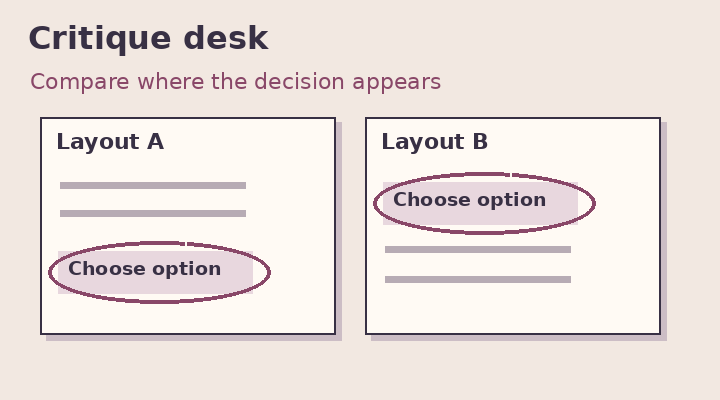
Which decision is the user making? Try the same task in two layouts. Name the trade-off behind the choice.
Design decisions
- Frame
- Name the task and the edge case that changes the decision.
- Agree
- Resolve the expected behaviour with the people who implement it.
- Reuse
- Record the rationale and test it against the next screen.
Outcome
The documented outcome was a repeatable set of interaction rules, a decision log and guidance used by engineering and shared with the client. The workshops were one contributor to the broader delivery programme.
What I would measure next
A useful measure of reuse is whether another team can implement the next instance correctly from the written rule.